
The teacher in Ecclesiastes
described life as the silver cord
He urged remembrance of The Eternal one
while there was still life and hope
because distractions existed then
though fewer than now
Now, we think our thoughts in chorus
zeitgeist-inhabited echo-chambers
A lie I’m tempted to believe may be
God helps those who help themselves
the Western adage for self-made success
Sure, efforts may reap rewards–but not always
I know that if I aim at nothing
I hit the goal of aimlessness every time
but self-made success is a dubious goal
You and I need friends and community
There is such a thing as society
Did we learn nothing from the pandemic?
Restaurants fed the sick and elderly
Essential workers in factories, hospital floors
supermarkets, water and waste management
cleaned, cared, and healed
No man was an island was writ large
Seeing community living at work
in villages and Eastern societies
with no clean water or public services
Nothing taken for granted except friend or neighbour
There’s a learning curve to harmonious living
in our age of war and discord
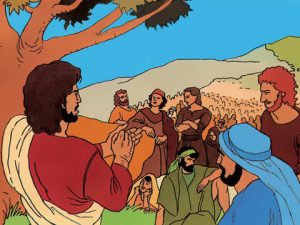
Jesus taught on a hillside two millennia ago
that the poor in spirit are truly happy
Humility precedes honour, pride before a fall
We can choose relational success or demise
Almighty graces mourners, heals and renews
It is not naïve to be gentle and trusting
Gratitude is a better way
Happy hopes of coming kingdom lets go of
the strain of grasping an inheritance here and now
Hungry and thirsty are happy
when facing reality and getting help
for pretending all’s well when it’s not
only aggravates the mind
No one can successfully live in denial
Relationships break down
The psychology of suppressed emotion
is vast and deep and causes disorders
The Almighty satisfies seekers
by bringing help and helpers
The burden lifter provides for a needy creation
answering and rewarding
The Messiah lived Solomon’s wisdom
His love took him to a cruel cross
Solomon couldn’t measure up
to his own wisdom

Pleading for her baby’s life, a woman kneels at the feet of King Solomon, relinquishing her claim to the contested child, thus identifying herself as the actual mother. 1 Kings 3:16–28. Nearby, a soldier prepares to follow the king’s order to cut the baby in two, while another woman, also claiming to be the mother, stands ready to take her half. This Roman wall painting from the House of the Physician in Pompeii is the earliest known depiction of a Biblical scene—a surprising find in a city better known for its brothels and erotic art than its religious paintings. So who commissioned this painting: a Jew, a Christian, or a gentile? Photo: Scala/Art Resource, NY.
https://www.biblicalarchaeology.org/daily/ancient-cultures/solomon-socrates-and-aristotle
Hebrew proverbs influence East and West and may also discuss ideas in goading or argumentative ways, but test philosophy by application to life and the law. Aristotle and many other philosophers, like Francis Bacon, Kierkegaard, Sartre, John Locke, David Hume, Popper, and even Marx, would agree with this approach for different reasons. The wise Hebrew King Solomon, who lived over four centuries before Socrates, was known for his applied wisdom.
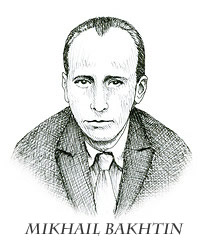
Russian philosopher Mikhail Bakhtin
A Rose Garden article describes dialogics which I began this blog with.
https://intotherose-garden.com/2013/09/20/dialogics-and-the-western-dichotomy-of-thought/
The dialogic of Bakhtin goes beyond dialectics. Rather than presenting competing ideologies, dialogics allow differences to exist in the same space; instead of ideological closure, the aim is to progress thought, not just resolve contradictions. Bakhtin goes further, arguing that all thought is inherently dialogical. No one speaks in a vacuum because everything you say is based on what was previously said and reactions to that. Language is dynamic and re-describes the world continually. Dialogics is part of speech, and the dialogical model creates cooperative learning environments by destroying hierarchies in public forums and education. The dialectic process dominates the West. It has uses with its debate and restrictive binaries, but dialogics is different and doesn’t aim at cut-and-throat solutions, allowing for free thought and new ideas. It suspends prejudice and frees up conversation and is increasingly needed when the educational model of lecturing isn’t enough.
Contradictory Realities in Psychology
We may directly relate to the following:‘I am doing the best I can, and I can do better’
‘I want to live, and I want to die’
‘I want to quit drinking, and I want to have a drink’
‘I love my partner, and I hate my partner’s tone of voice when she’s angry’
‘Change is the only constant’
Contradictions in human experience are core to Dr. Marsha Linehan’s ground-breaking dialectic therapy, which stresses that opposites coexist. A classic example is how after losing a loved one through a longed illness, we feel sad for the loss, and relieved that the loved one’s suffering is over.
Dialectics in West and East
In the West, Aristotle established three foundational rules governing rational discussion and truth:
- a) Law of Identity, that a thing is what it is. b)The Law of Non-Contradiction, that a statement can’t be both true and false at the same time- e.g. you can’t be entirely alive and entirely dead now. c) The Law of the Excluded Middle, a statement is true or false with no third middle option. Either it is raining, or it isn’t.
Another, rather contradictory aspect of Western systems of thought is abstract and metaphysical, which stems from Plato, whose mind over matter thinking is so pervasive that we may not perceive its influence. This Greek ‘influencer’ elevated thinking above humanity. The Marxist’s historical materialism and other philosophers of his time opposed his ideas, placing matter over mind. Dialectics may allow thesis and antithesis, hopeful of a synthesis–the triad, a basis for argumentative Western society.
Dichotomies are strengthened–all ideology and ideas are binaries that must contradict or supplement each other, always opposite in meaning, and one more important than the other.
Confucius and the Analects
Confucius, who came after Socrates, taught a more seamless holistic philosophy than Western logic offered, described as “focusing on the field (the whole context) rather than just the focus (the isolated object).” He influenced broader Chinese thought, viewed change as dynamic and inclusive of complementary opposites, yin and yang, leading to the “Middle Way” by seeking harmony and balance between the two sides, not negating either. The Analects and later Confucian texts are about human relationships, moral agency, and social roles. An example of this is Confucius giving different explanations of benevolence (Ren) to different disciples, bringing holistic approaches rather than a strict definition. A situation can mean different things to each disciple.
The Arts and Story (Applied Philosophy)
Illustrating contradictory realities is a contribution the arts can make to humanity, because of how well this is done, for example, through underdog stories–perhaps the commonest contradictory human experience–and who doesn’t love those?
We encounter stories in all shapes, sizes and media, in books, graphic novels, poems, films,TV, video games, following a protagonist, the unlikely hero, as they meet obstacles and grow through adversity–contradictions are inherent, inescapable and inspiring. It cannot be accidental that our world is so full of these.
A Real Life Under-dog Story
Over two decades ago, while working voluntarily as a doctor in an Addis Ababa mission clinic, I met a friend helping in the dental and medical clinics. She has since become one of our closest Ethiopian friends, especially after her family’s move to the UK–they live about an hour from our home in Manchester now. While working with children and young adults in Addis, they sought asylum in the UK, unable to make ends meet, and burdened with the care of a very disabled middle son.
When a very young child, she had been ‘lent’ by her mum to her sister who had no daughters. That decision led to a tragic series of events, and our friend ended up fending for herself, rejected by her aunt’s family after both her aunt and mum had passed away. However, I had the privilege of witnessing her growth in character and ability when as a young woman, who hadn’t finished her education, she took the English GCSE equivalent (more than once), then a degree, while living in a little compound of mud huts in urban Addis Ababa, surrounded by children, more disadvantaged than she had been. She taught, inspired, and shared her few resources with these children who seemed to be drawn into her influence–and they looked out for her too, by taking care of her tiny home and few possessions and running errands. It was to be a pattern that became her calling. More recently, she set up a charity for children with additional needs and their families. She also wrote about it, helping her diaspora, and the families she supports in Addis Ababa live well, grappling with the challenges of raising a child with intellectual needs. Her big-hearted perseverance has become known in her community, and her incredible husband encourages all her endeavours. Her story is full of experiences that demonstrate lived realities: of being hungry and thirsty but finding satisfaction, of humility preceding honour, and of healing following the acknowledgement of pain.
Overcoming, an Appeal for Application
I’ve also encountered universal, conflicting, and often serendipitous realities in my everyday clinical settings where a common grace seems to be available, demonstrated in many overcomer and ‘success’ stories–but invariably each story also has discouragements, tears, fears, trying again. The truths in these stories can be stranger than fiction. Perhaps life has become too full for you to appreciate the inspiring stories you encounter, or your own challenges are overwhelming, or other distractions have overtaken you.
I once reviewed a book written by a psychologist who studied people in war zones around the world. His greatest surprises weren’t the worst horrors that human beings were capable of–but the wonders of kindness, humanity, and selflessness, of those who loved and looked out for others–that he witnessed in the middle of the horrors, every time. Acknowledging these contrasts led him on a spiritual journey. That humanity perpetrates horrors is a truism, and we each need to respond to the existence of good and evil, and if we remain open, this may guide us to explore deeper spiritual truths.